

Ketamine Assisted Therapy
Rooted in Athens, Serving All of Georgia, Florida, & South Carolina

Why Ketamine + Therapy?
When standard treatments aren't providing the relief you're looking for, ketamine can be a powerful tool. Sometimes the nervous system needs a little more flexibility before meaningful change can take root. By inducing neuroplasticity, Ketamine can help loosen rigid patterns of thinking, feeling, and relating, creating an opportunity for healing and growth. The medicine may open the door, but lasting transformation comes from what you do with the experience. Together, we'll work to turn insight into action and create meaningful change that extends far beyond the ketamine sessions themselves.

Ketamine Treatment Options
Ketamine is a versatile tool and different interventions fit different clients. The following options are available, and a consultation call can help you determine your unique path.
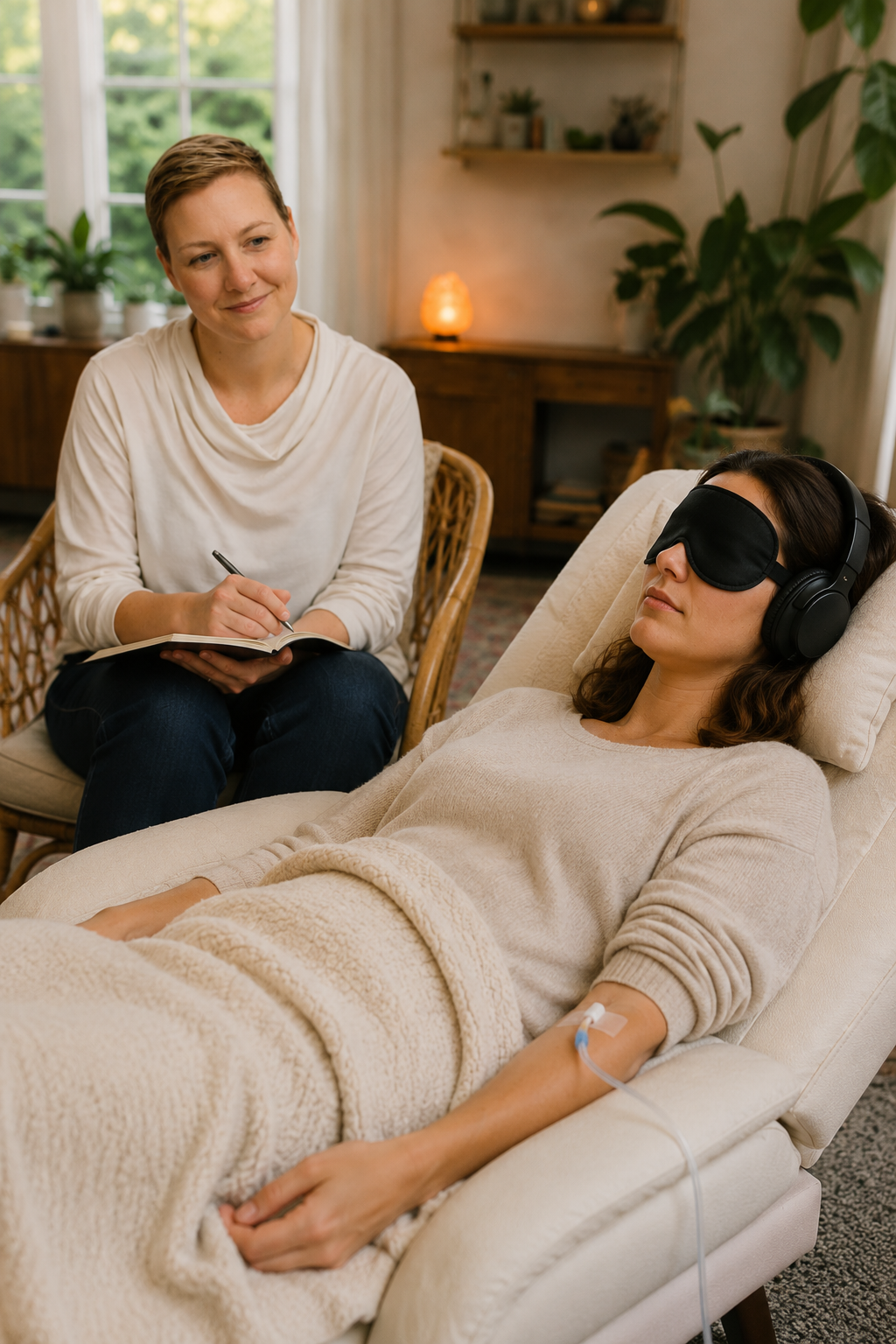
AI Image to Protect Confidentiality
-
I work with a local prescriber to provide oral troches. These troches are held in the mouth and absorb into the oral mucosa. Ideally, clients schedule a 2 hour session to include preparation, dosing, and integration. Some clients with appropriate clinical presentation and safe set and setting can administer the troches a few hours before bed, journal, and meet with me for integration the next morning. I work to create individualized treatment plans that balance client acuity, treatment need, and access.
-
I am currently accepting clients to my waiting list for G-KAP or Group Ketamine Therapy. This therapy is done in small cohorts of 5 using oral ketamine for three Saturday sessions. This powerful combination of medicine plus community support and therapy is how I believe healing work was always meant to be. It’s only in this modern age that healing is a private and isolated experience. Humans have always healed around a fire, in community, with wise teachers. Group ketamine takes advantage of our primal need to be witnessed and held safely in community along with ketamine’s neuroplasticity benefits. This is a one month intervention that is designed to be more affordable. It may not be the right intervention for more acute cases.
-
I work with local IV clinics to design a program of treatment. IV can be a compelling treatment option for…
Interrupting suicidality
Managing anxiety as IV can be stopped upon request
More acute or treatment-resistant presentations
Individuals who do not have access to safe set and setting
IV interventions are highly supported by the research and are generally administered in a series of 6 infusions spaced about 3 days apart.
-
Some clients may do well using low-dose oral ketamine as a tool to increase therapy session efficacy. With low dose ketamine, I guide clients on a meditation journey to meet with and heal aspects of themselves in a safe imaginal space. The medicine can help clients go deeper, move past defenses, and release long held beliefs and behaviors.
-
Spravato is an FDA approved ketamine nasal spray that is always administered in a psychiatrists office. The benefit of this method is that it is more likely to be covered by insurance. Clients receive the medicine at a psychiatrists office and must stay there for 2 hours.
I am not aware of a local provider, but I am happy to offer the same preparation and integration sessions around Spravato as other methods.
Psychedlic Assisted Psychotherapy


Charlie Shockley, LCSW, PATP
I am proud to be among the first therapists in Georgia to specialize in and become certified in Psychedelic-Assisted Psychotherapy. While ketamine is currently the only legal psychedelic medicine that I can directly facilitate, I also provide preparation and integration support for individuals who have chosen to pursue other psychedelic experiences on their own. My role is not to encourage or discourage these choices, but to help reduce harm and ensure that those who choose this path have access to informed, compassionate, and supportive care.
Psychedelic experiences can create unique opportunities for learning, insight, and healing by increasing psychological flexibility and neuroplasticity. However, insight alone is rarely enough. Without meaningful preparation and integration, people can find themselves chasing altered states rather than creating lasting change. Safety, set, and setting are essential, and these experiences are not without risks. For some individuals, psychedelics can contribute to overwhelming psychological distress, spiritual emergencies, mania, or psychosis. Whether you are considering a psychedelic experience or seeking support afterward, I am here to help you make informed decisions and create the safest possible conditions for your mind, body, and environment.

Psychedelic Means “Mind Manifesting”. It’s more than a substance, it is…
a way of seeing
a state of being
a healing path
I am a psychedelic-oriented counselor.
I work from a psychedelic or Jungian philosophy that challenges the conventional, symptom-management model of healing. This approach is not about substances—it is about a radically different way of understanding suffering and transformation. A psychedelic orientation recognizes that most forms of distress come from disconnection, avoidance, and an overprotective ego that tries to keep us safe by keeping us small. Instead of helping clients “manage” these defenses, I guide them through an in and through process: turning toward the very experiences the ego has labeled as dangerous. This work embraces the idea that the ego’s rigid control is often the source of suffering, and that true change requires meeting the shadow—the exiled, painful, unseen parts of the self—with deep compassion rather than fear. A psychedelic-oriented counselor helps people expand beyond old narratives, dissolve limiting identities, and reconnect with the wholeness that has always been there. It is a bold, compassionate, consciousness-expanding orientation to healing—one that invites not escape, but awakening.
Psychedelic, at its core, means mind-manifesting. It describes a mode of awareness—one that notices layers beneath the surface, holds contradictions without panic, and treats experience as information rather than threat. You can live psychedelically without ever ingesting anything. It’s a posture toward reality: curious instead of defensive, participatory instead of passive, humble enough to be changed by what you encounter.
A psychedelic way of being values inner exploration, pattern recognition, symbolic thinking, and the recognition that the “self” isn’t a single voice but a moving ecosystem. It invites you to track what’s happening within with the same attention you give to what’s happening around you. It widens the frame. It reveals options that rigid consciousness hides.
Medicines can catalyze that state, but they aren’t the state itself.
The point isn’t the compound; it’s the capacity it highlights.
Psychedelic as a worldview says: the mind is larger than its habits, reality is larger than its labels, and transformation is always available. Substances can open the door—but the psychedelic way of being is learning to walk through it in ordinary life, unassisted, with eyes open.
I’m a licensed clinical social worker (LCSW) and the founder of a multi-specialty therapy practice offering trauma counseling, addiction counseling, and ketamine-assisted psychotherapy (KAP). While I treat a range of issues, my clients often have substance use or other maladaptive patterns rooted in trauma. I’m based in Athens and provide services virtually from my little cabin in the woods. My services are available throughout Georgia. I’ve provided ketamine-assisted psychotherapy since 2019 — combining evidence-based addiction and trauma work with psychedelic-informed modalities for clients seeking deeper healing and transformation.
I specialize in helping individuals caught in cycles of trauma, rigid thinking or behavior patterns (ego), like substance misuse, perfectionism, people pleasing, codependency, avoidance, depression, and anxiety. My clinical training covers evidence-based therapies such as EMDR, Acceptance and Commitment Therapy (ACT), Motivational Interviewing (MI), and Internal Family Systems (IFS), which I integrate with Ketamine Assisted Psychotherapy (KAP) when indicated.
My mission is to offer clients a personalized, compassionate, and integrative path to recovery and self-discovery. Whether through talk therapy alone or in combination with ketamine-assisted sessions, I’m dedicated to supporting you in uncovering underlying trauma, reshaping unhelpful patterns, and integrating new insights into everyday life for long-term wellbeing.
If you’re searching for a therapist who understands trauma and addiction, and who embraces both traditional and psychedelic-informed methods, I’m ready to walk with you — offering clear guidance, supportive presence, and a safe space for transformation.
To connect with me, please use the schedule consultation button. It is linked directly to my calendar.
You may also text or call 706-389-9684.
More About Me

Q&A
-
No, but I can refer you to a ketamine prescriber who only works with clients receiving true Ketamine Assisted Psychotherapy.
I also work closely with ketamine infusion clinics.
-
Ketamine has shown promising results in helping individuals with certain mental illnesses, and its effectiveness is still an area of ongoing research. The exact mechanisms of how ketamine works to alleviate symptoms of mental illness are not fully understood, but there are several theories:
Encouraging cognitive flexibility vs. rigidity: It is postulated that the the medicine shuts down the area of the brain (Default Mode Network) where the ego resides, and encourages new and varied connections throughout the brain. It is as though the ego wants to run a certain program, and the medicine pauses it. In this way, clients are able to see an alternative way of being and access feelings of safety, joy, and connection that the ego blocks. This is a difficult experience to forget and tends to lead to a more flexible self-identity vs. an ego-based identity that consistently needs to defend itself or color reality in a way that is predictable.
Glutamate Modulation: Ketamine is an N-methyl-D-aspartate (NMDA) receptor antagonist, which means it affects the glutamate neurotransmitter system. This modulation may lead to increased synaptic plasticity, promoting the formation of new neural connections.
Neuroplasticity: Ketamine has been associated with promoting neuroplasticity, which is the brain's ability to reorganize and form new neural connections. This may contribute to improved mood and cognitive function.
Inflammatory Response: Some studies suggest that ketamine may have anti-inflammatory effects, and inflammation has been linked to certain mental health conditions. By reducing inflammation, ketamine might contribute to symptom relief.
Brain-Derived Neurotrophic Factor (BDNF): Ketamine has been found to increase the production of BDNF, a protein that supports the growth and maintenance of neurons. This increase in BDNF levels may play a role in the antidepressant effects of ketamine.
Rapid Onset of Action: Unlike traditional antidepressants, ketamine often produces rapid effects, sometimes within hours. This quick onset of action can be crucial for individuals in acute distress.
It's important to note that while ketamine has shown promise, it is not a first-line treatment for all mental health conditions, and its long-term effects and safety are still being studied. Ketamine treatment is typically administered under medical supervision, and its use for mental health purposes is often prescribed "off-label" by healthcare professionals. It's crucial for individuals considering ketamine treatment to discuss the potential benefits and risks with their healthcare provider. More info.
-
In 2017, I completed my master's degree in clinical social work at the University of Georgia, obtaining the qualifications to offer mental health counseling.
I am also a Certified Psychedelic Assisted Therapy Practitioner through the Integrative Psychiatry Institute. This intensive year-long certification program has equipped me to work with a range of psychedelic substances, including specialized training in MDMA therapy under the guidance of the Multidisciplinary Association of Psychedelic Studies (MAPS). I have also received additional Ketamine-specific training from PRATI and Fluence.
I have additional training in Somatic and Attachment Focused Eye Movement Desensitization and Reprocessing (EMDR) through the Personal Transformation Institute.
Generally, my extensive experience spans various therapeutic modalities such as Acceptance and Commitment Therapy (ACT), Motivational Interviewing (MI), and Internal Family Systems (IFS). This diverse training enables me to offer a comprehensive and personalized approach, tailored to address the unique needs of each client. More info.
-
Yes and no. Some options such as Ketamine, breath work, sound and light immersion, and certain herbal entheogens are legal. Ketamine is 100% legal, available, and a powerful option for healing.
Classic psychedelics like psilocybin, ayahuasca, MDMA, ibogaine, LSD, mescaline, etc. are still illegal.
For those who have indepentently chosen to use non-legal substances, I provide preparation & integration therapy, based on principles of harm reduction.
It is my belief that all humans seeking healing deserve safety, support, and bodily autonomy. In other words, you have a right to do with your body what you like. I believe making the choice to pursue psychedelics should not mean you have to do them in a way that is psychologically unsafe.
According to SAMSHA, Harm reduction, “emphasizes engaging directly with people who use drugs to prevent overdose; improve physical, mental, and social wellbeing; and offer low barrier options for accessing health care services, including substance use and mental health disorder treatment.”
The approach was originally developed to assist individuals with opioid use disorders access life-saving care that doesn’t require abstinence - a major barrier to people seeking help. It is now being used as a strategy to support individuals who decide to use substances outside standard psychopharmacology.
Harm reduction does not promote the use of psychedelics or other medicines, but recognizes that people simply ARE going to do this, and these individuals also need support.
Psychedelic therapy is experiencing a kind of boom from mushroom products lining the shelves of Target to Oprah hosting psychedelic authors on her podcast to every head shop selling nootropic mushroom gummies. One might get the impression that these substances are mainstream and harmless. This isn’t true, especially for people with mental health and substance use disorders.
Psychedelics are non-specific amplifiers of internal experiences. They may amplify connection, or they may amplify that time a loved one broke your heart. In fact, this is how they work, bringing up themes of life, death, transition, growth, and decay. When you have a big hurt in your mind-body, the medicine may help you heal yourself by bringing forth that fruitful darkness. No one should attempt this alone.
-
My clients are seeking growth and transformation. They wish to unburden themselves from the cognitive, emotional, and spiritual rigidity our modern lives create. They may be trying to work through a mental injury or navigate big life transitions. No matter what the need is, having a knowledgeable guide can help you avoid harm and optimize your healing.
Addiction / Substance Use Spectrum
I started my psychotherapy career working with substance misuse clients and am happy to work with people in recovery. Honesty about substances of use is critically important to insure safety. A period of sustained abstinence or moderation is necessary.
Mood Disorders
Most clients who reach out sharing that they have depression or anxiety are misdiagnosed and thus ineffectively treated. Yes, they experience the symptoms of depression and anxiety, but the source is more often mental injury or trauma. It is not a “chemical imbalance.” I put those words in quotes because it is well known that they were a marketing tool used by pharmaceutical companies to sell medicine to treat a physical/medical problem. There is zero evidence that such a chemical imbalance exists and we simply don’t know how antidepressants work. Sadly, millions believe they are sick, broken, or helpless in the face of an invisible foe that can only be managed with life-long medications. This is tragic.
So, what might actually be happening is we get hurt and in response develop rigid aspects of self that don’t know how to live without protection. Hypervigilance, shutting down, avoidance, perfectionism, people pleasing, codependency, and toxic independence are all examples of protections humans develop that contribute to these diagnoses. These complex self-systems often present like depression or anxiety. The good news is, these hurts can be healed without the need for life long medication.
Trauma (PTSD/CPTSD)
I regularly work with clients who have experienced trauma, using methods like EMDR and IFS to heal and learn to regulate a chronically dysregulated nervous system. Clients diagnosed with PTSD or CPTSD should never trip alone. The risk of re-traumatization is too high.
Neurodivergent (ADD, ADHD, ASD)
I am happy to provide a safe therapeutic experience for all neurodivergent clients. I work hard to assure my neurodivergent clients are not further harmed by any expectation of masking. I help people find the most authentic version of themselves, and it is a special joy to help my neurodivergent clients feel they can fully be themselves.
I help clients stuck in these rigid patterns (depression, anxiety, PTSD, CPTSD, SUD) get unstuck. I help clients discover their pure life force, joy, depth, and capacity to peacefully accept life’s experiences.
As a psychotherapist, I can assess for underlying trauma, dissociation, or other presentations that may be challenging within your medicine experience. I can guide you, preventing harm and promoting your vision. As a spiritual human, I’ll bring a calm presence, an open mind, and gently support your path towards deep connection to self and source.